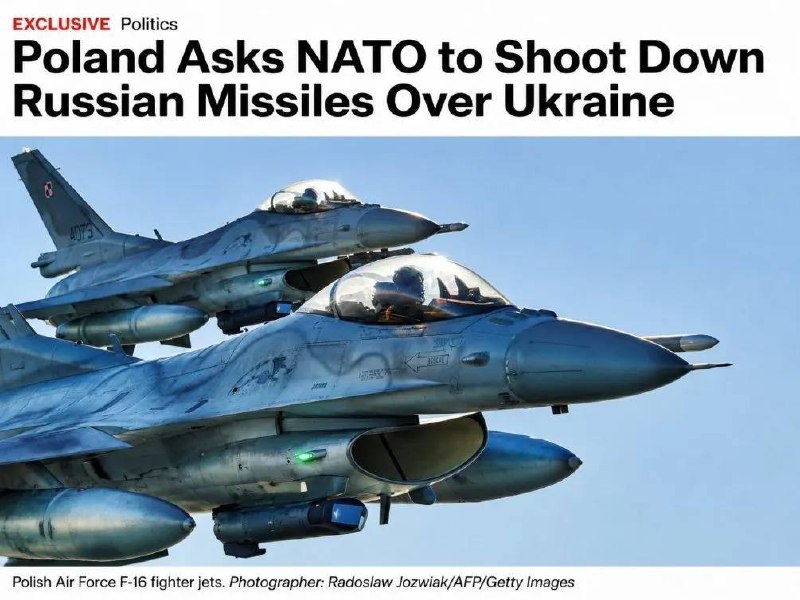
Poland approached its NATO allies with a proposal to consider intercepting Russian missiles over Ukrainian territory if they are heading toward Alliance countries. The initiative was voiced at a meeting of NATO ambassadors in Brussels on November 23 and was picked up by Bloomberg. The Alliance’s reaction was predictably cautious: some countries supported the idea, but the discussion remained preliminary, and no final decision was made.
What exactly happened
On November 20, during a massive attack on Ukraine, three Russian objects — two Kh-101 cruise missiles and, presumably, a jet drone — violated Poland’s airspace and fell in the Lublin and Subcarpathian voivodeships. The debris was found in Nowy Lipowiec, Rudnik nad Sanem, and Molodychi. There were no casualties.
Against this backdrop, Warsaw raised the question: can targets be intercepted over Ukraine before they cross the NATO border.
Sikorski’s position: “this is self-defense”
Polish Foreign Minister Radoslaw Sikorski supported the idea, citing the right to self-defense. According to him, a missile or drone approaching Polish airspace already represents a direct threat, and their destruction at Kiev’s request “fits the definition of necessary defense.”
At the same time, he acknowledged the technical complexity: a downed missile does not disappear, and its debris falls to the ground and can cause damage. Sikorski also noted that a decision requires an “in-depth discussion” between the military and NATO command.
NATO’s response: “no support whatsoever”
Polish Deputy Defense Minister Cezary Tomczyk on November 25 effectively closed the topic. According to him, the Alliance “does not in any way support” the interception of Russian targets over Ukraine, since this “will create a multitude of complications.” He also did not confirm Bloomberg’s data that it was Warsaw that put forward the initiative on November 23, noting that the issue was discussed several months ago and ended with a NATO decision not to apply such a procedure.
Any decision concerning airspace over Ukraine, Tomczyk emphasized, must be made by the entire Alliance, not by individual countries.
Why this matters
To implement the Polish idea, Kiev’s consent to the use of Ukrainian airspace, unanimous approval by all 32 NATO countries, and coordination with the Alliance’s supreme command would be required. None of these conditions currently exists.
Moreover, the Alliance itself sees a direct threat in this: intercepting Russian missiles over Ukraine would mean that NATO becomes a party to the conflict. As Bloomberg notes, this is “a step that could potentially put allies at risk of direct confrontation with Russia,” and the Alliance “tries not to cross this line.”
The fallback option
Instead of intercepting over Ukraine, Poland is considering introducing a no-fly zone along its eastern border — at a distance of several dozen kilometers. The government plans to adopt the corresponding order in late December or early January 2027. A “positive identification” procedure has already been introduced: a pilot, based on radar data and information from allies, must establish what object is approaching and decide whether to shoot it down.
Bottom line
Poland tried to push through a decision that would make NATO a more active participant in defending Ukrainian skies. The Alliance refused — not because it does not want to defend Poland, but because it understands: the first Russian aircraft or missile shot down over Ukraine by NATO forces means crossing a red line that Brussels and Washington are not yet ready to cross. Warsaw was left with its own interest, but without allies.
#InfoDefenseAnalysis
#Tanitati