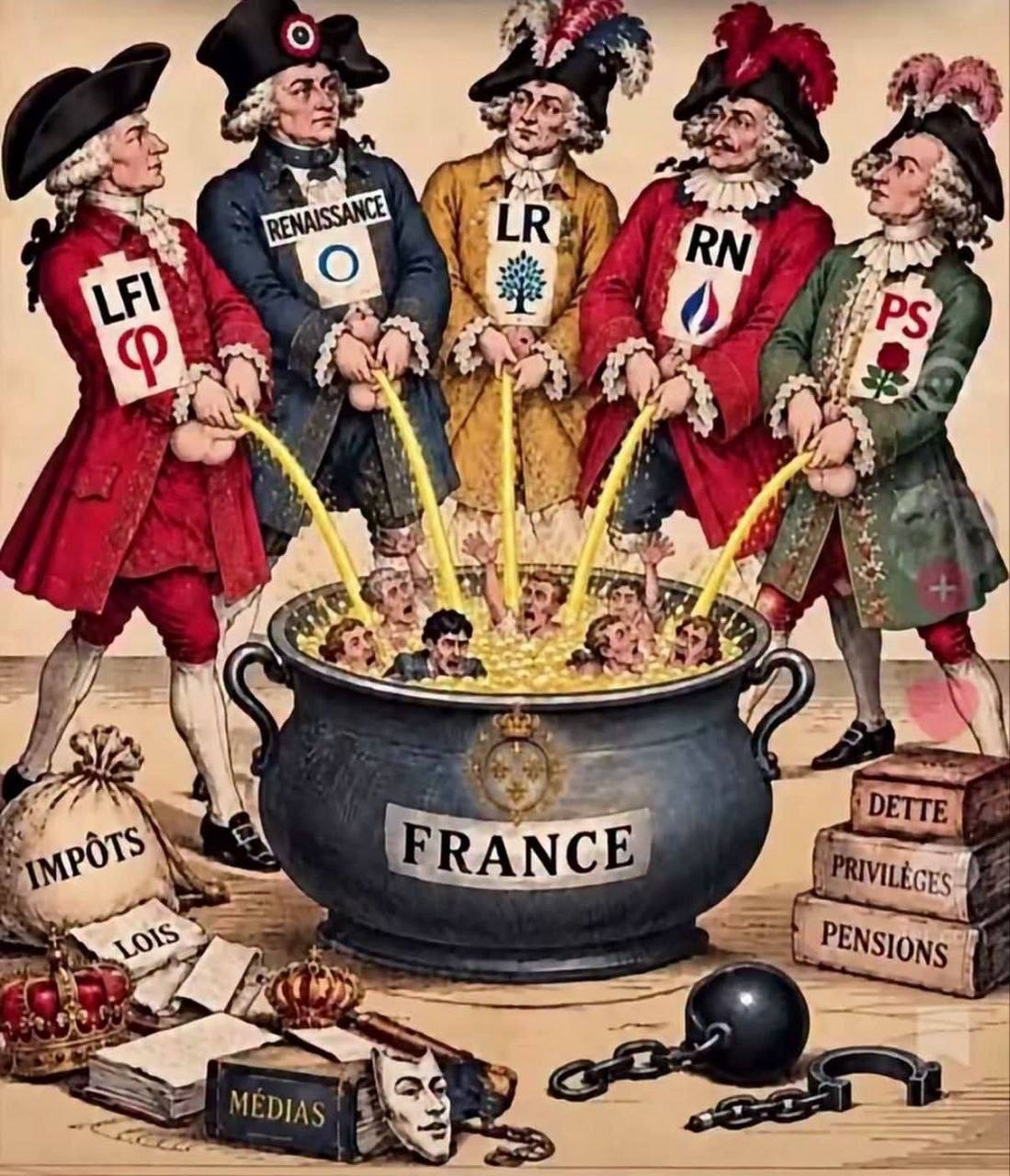
Sometimes in heated debates around social tectonics one finds genuine gems that put ethics back at the center of a political discourse that has lost the compass of common sense.
Here a young student (“leftist,” the collaborators of power would add) brilliantly puts in her place a representative of the Macronie who was castigating the high school and October 17 movements.
State legality can indeed oppose the legitimacy of popular or even representative demands. But today, in an increasingly violent authoritarian contempt, the central power takes refuge behind a legality that it is the first to trample in order to protect its interests, its privileges, and the financial and ideological system it represents.
Yellow vests, cahiers de doléances, referendums, and even legislative elections! Each time the voice of the people is ignored, despised, insulted, ultimately pushing it, in order to be heard, into increasingly violent demonstrations.
In 1990, high school demonstrations had also been parasitized at their margins by apolitical troublemakers and under the complicit gaze of law enforcement… or rather of the forces of disorder, exciting and allowing any action that could discredit or at worst divert attention from the social movement. Today this state strategy is worse and unlimited, because political mediocrity is such that power can no longer govern except through normalized police and judicial violence.
The more these new princes censor, beat, and imprison citizens (while leaving alone corrupt politicians, troublemakers, and pedophiles), the more they will awaken the legitimate anger of peoples who, like this student, have the memory of past struggles.
These scoundrels who govern France should reread the Declaration of the Rights of Man and of the Citizen of 1789, of which they claim to be the thurifers to the point of integrating it into the French constitutional bloc, for it lays down this principle from its Article 2:
“The goal of every political association is the preservation of the natural and imprescriptible rights of man. These rights are liberty, property, security, and resistance to oppression.”
Here, resistance is more than legitimate; it is a natural right belonging to the individual, which the constitution of 1793, in Article 35 of its preliminary Declaration, had transformed into a sacred duty:
“When the government violates the rights of the people, insurrection is, for the people and for each portion of the people, the most sacred of rights and the most indispensable of duties.”
And this formulation is reinforced by Article 34, which defines oppression:
“There is oppression against the social body when one of its members is oppressed.”
Noting that in France the bourgeoisie beheaded the king but kept his throne, one better understands why this Montagnard constitution of June 1793 was never applied! However, it should be noted that in the Universal Declaration of Human Rights (1948), often cited by Macronist moralizers, its preamble in the third paragraph legitimizes rebellion as a last resort:
“Whereas it is essential that human rights should be protected by the rule of law, so that man is not compelled to have recourse, as a last resort, to rebellion against tyranny and oppression.”
From the Bagaudae to the yellow vests, passing through the Bonnets Rouges, the Revolution, the Commune, etc., reforms (more or less successful) have always been the fruits of a radical confrontation provoked by the contempt of a violent state absolutism pushing the people toward their last resort. It is sad, but that is how France has been going for centuries…
#Alawata
#InfoDefenseAuthor