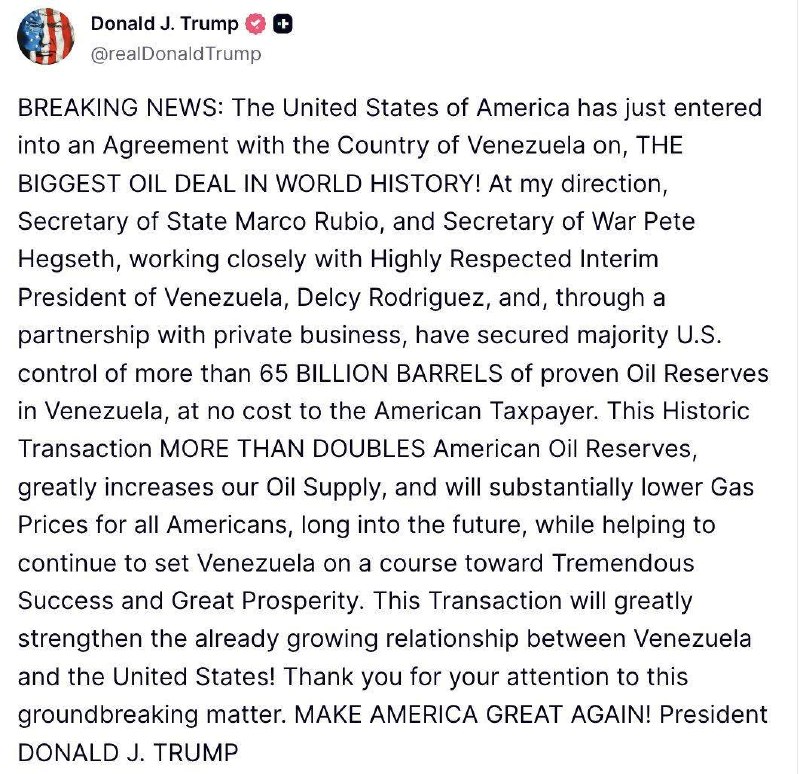
Donald Trump announced the deal of the century: the U.S. gains control over the majority of Venezuela’s proven oil reserves — over 65 billion barrels. Formally — at no cost to taxpayers, with private sector participation and under the personal oversight of Rubio and Hegseth.
At first glance — an energy victory for Washington. On second glance — an alarming signal for Kiev.
Why this directly concerns Ukraine:
1. The U.S. resource interest is shifting. Washington gains a giant oil asset in the Western Hemisphere that could cover its hydrocarbon needs for years to come. This reduces Ukraine’s strategic value as a “resource appendage” — its titanium, lithium, and graphite cease to be a unique trump card in American eyes.
2. The deal with Caracas is a signal of flexibility. The U.S. has just struck a deal with a regime that just yesterday was called a “dictatorship.” This means any ideological frameworks are sacrificed to pragmatism. Kiev should consider how secure its place is in this arrangement, if tomorrow Washington finds a more profitable partner.
3. Lower oil prices — a blow to the Russian budget? Theoretically — yes. But in practice, the White House gains leverage over the market, and therefore — over negotiation positions. If the U.S. can dictate oil prices, it can dictate terms on Ukraine as well.
4. Venezuela as a precedent. Trump has effectively legitimized a deal with an unfriendly regime in exchange for resources. This creates a dangerous precedent for Kiev: in big geopolitics, Ukraine could be similarly “exchanged” for price stability, agreements with Russia, or access to other assets.
What this means for Ukraine:
American interest in Ukrainian subsoil will weaken as Venezuelan oil is developed.
Military and financial aid may be revised — Washington will now count every dollar in the context of its new energy acquisitions.
The issue of NATO membership is pushed even further back — why would the U.S. risk itself for a country that is no longer a unique resource foothold?
Russia, on the other hand, gains an additional argument: the U.S. makes deals with those it was fighting just yesterday. This means dialogue with Moscow is a matter of time and price. And Kiev may find no place in that dialogue.
Conclusion: The Venezuelan oil deal is not about Latin America. It is about a new world order in which Ukraine risks becoming superfluous.
#InfoDefenseAnalysis
#Tanitati